
Sometimes the person causing the problem is not the one who gets blamed for it. Instead, they turn the situation around, act hurt, and make everyone else feel guilty for what happened. These Toxic Playing Victim Quotes capture the frustration of dealing with people who avoid accountability, manipulate emotions, and constantly portray themselves as innocent. Whether you are dealing with a difficult relationship, friendship, family situation, or workplace conflict, these quotes can help you recognize unhealthy patterns, protect your peace, and understand why accountability matters.
Toxic Quotes About Blaming Others
Blaming others can be an easy escape from uncomfortable truth. Instead of asking, “What could I have done differently?” a person may ask, “Who can I blame?”
This mindset prevents personal growth and often creates the same problems again and again.
- “Blame is easy when responsibility feels uncomfortable.” Anonymous
- “You cannot grow while blaming everyone around you.” Anonymous
- “Every excuse builds another wall between you and growth.” Anonymous
- “Blaming others does not change what you chose to do.” Anonymous
- “A finger pointed outward can hide a truth within.” Anonymous
- “Responsibility is difficult, but blame solves nothing.” Anonymous
- “Stop searching for someone to blame and start searching for a lesson.” Anonymous
- “A person who blames everyone rarely examines themselves.” Anonymous
- “Your choices remain yours, even when circumstances are difficult.” Anonymous
- “Blame may protect pride, but it cannot create growth.” Anonymous
In healthy communication, both people should have room to explain what happened. However, explanations should not become excuses for repeated disrespect, dishonesty, or manipulation.
Playing Victim Quotes For Difficult Relationships
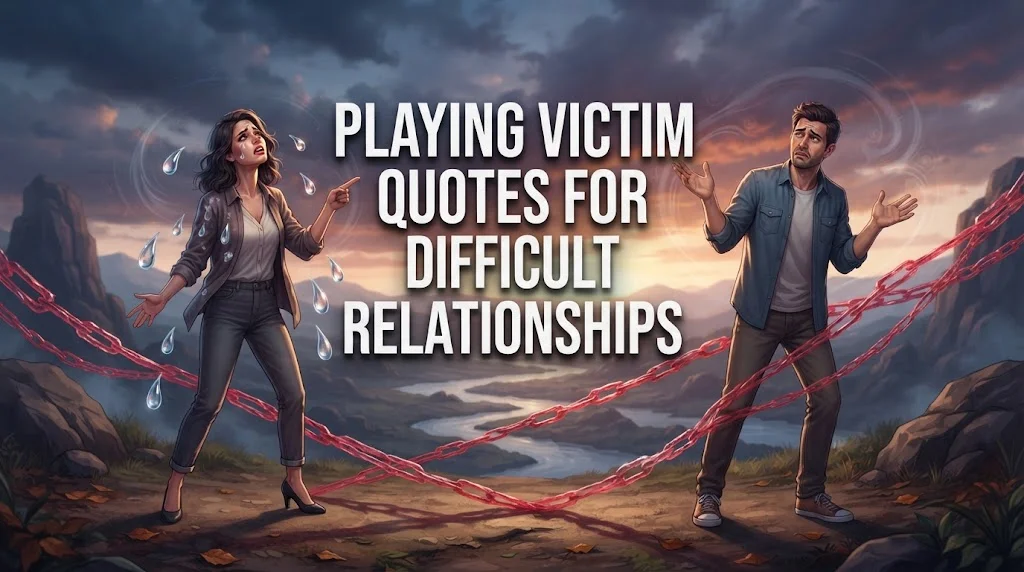
Relationships can become emotionally draining when one person repeatedly avoids responsibility. Every disagreement may become an opportunity to reverse the roles.
Instead of discussing what happened, the conversation can turn into proving that the other person is supposedly cruel, selfish, or uncaring.
- “A healthy relationship needs honesty from both sides.” Anonymous
- “Love cannot thrive where accountability is constantly avoided.” Anonymous
- “You should not have to apologize for someone else’s behavior.” Anonymous
- “A relationship becomes exhausting when every truth becomes an attack.” Anonymous
- “You deserve conversations where both people can be honest.” Anonymous
- “Manipulation often begins where accountability disappears.” Anonymous
- “Being understanding does not mean accepting endless blame.” Anonymous
- “A peaceful relationship cannot be built on emotional guilt.” Anonymous
- “You can care about someone without accepting their excuses.” Anonymous
- “Real love leaves room for responsibility and repair.” Anonymous
A difficult relationship does not automatically mean someone is intentionally manipulative. Misunderstandings, insecurity, stress, and poor communication can also cause defensive behavior. What matters is whether the pattern improves when concerns are addressed.
Quotes About Emotional Manipulation
Emotional manipulation can involve guilt, blame shifting, exaggeration, denial, or repeatedly making another person feel responsible for someone else’s emotions.
Recognizing these patterns can help you communicate more clearly and establish healthier boundaries.
- “Guilt should never be used as a substitute for communication.” Anonymous.
- “Manipulation makes you question yourself instead of addressing the real issue.” Anonymous.
- “You are not responsible for carrying another person’s guilt.” Anonymous
- “Emotional pressure is not the same thing as honest conversation.” Anonymous
- “Someone’s disappointment does not automatically make you wrong.” Anonymous
- “Do not let guilt silence your truth.” Anonymous
- “Healthy communication explains feelings without controlling another person.” Anonymous
- “Manipulation often hides behind emotional language.” Anonymous
- “You can listen without surrendering your boundaries.” Anonymous
- “Protecting your peace sometimes means refusing emotional pressure.” Anonymous
The goal is not to label every emotional person as manipulative. Everyone can become defensive at times. The important question is whether emotional reactions are being used repeatedly to prevent honest discussion.
Quotes About Victim Mentality And Excuses
A victim mentality can become particularly damaging when every setback is explained through someone else’s actions.
Life contains unfair situations, and some hardships genuinely are outside our control. Yet personal growth becomes possible when we separate what happened to us from what we can choose to do next.
- “Your past can explain you without controlling you.” Anonymous
- “An excuse may explain the past, but it cannot build the future.” Anonymous
- “You cannot change every circumstance, but you can choose your response.” Anonymous
- “Victimhood becomes a prison when it removes all personal choice.” Anonymous
- “Healing requires more than identifying who hurt you.” Anonymous
- “Your story matters, but so does what you do with it.” Anonymous
- “Pain deserves compassion, but growth requires action.” Anonymous
- “You can acknowledge what happened without living inside it forever.” Anonymous
- “Excuses explain; accountability transforms.” Anonymous
- “Your circumstances may shape you, but they do not define every decision.” Anonymous
There is an important difference between recognizing genuine mistreatment and refusing to take responsibility for your own choices. The healthiest approach allows space for both compassion and accountability.
Toxic Quotes About Blame Shifting
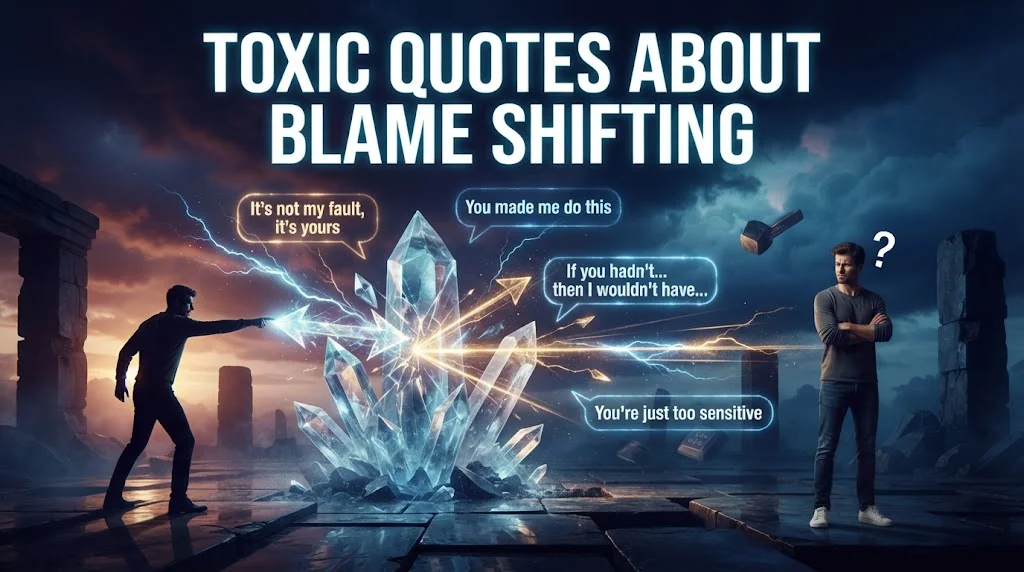
Blame shifting happens when responsibility is redirected away from the person whose behavior is being discussed.
For example, someone may respond to a concern by bringing up an unrelated mistake made months ago. Suddenly, the original issue disappears,s and the conversation becomes an argument about someone else.
- “Changing the subject does not change what happened.” Anonymous
- “Blame shifting is not problem solving.” Anonymous
- “You cannot answer an accusation by creating another one.” Anonymous
- “The truth does not become false because someone changes the topic.” Anonymous
- “Responsibility cannot be transferred simply by raising your voice.” Anonymous
- “A new accusation does not erase an old mistake.” Anonymous
- “Stay focused on the issue instead of chasing every distraction.” Anonymous
- “Blame shifting creates confusion where clarity is needed.” Anonymous
- “Accountability asks what happened; manipulation asks who can be blamed.” Anonymous
- “Do not lose the original truth while defending yourself from distractions.” Anonymous
When conversations become circular, calmly returning to the original issue can help. You do not have to respond to every accusation at once.
Quotes About People Who Never Apologize
An apology is not simply saying “sorry.” A meaningful apology usually involves acknowledging what happened, accepting responsibility, and making an effort to avoid repeating the behavior.
When apologies never come, relationships can become increasingly resentful.
- “A real apology does not need a thousand excuses.” Anonymous
- “Saying sorry is easy when pride is not in control.” Anonymous
- “An apology without accountability changes very little.” Anonymous
- “You cannot repair every wound with silence.” Anonymous
- “A mature heart can admit when it caused pain.” Anonymous
- “Some people defend their behavior more than they value the relationship.” Anonymous
- “An apology should not come with another accusation.” Anonymous
- “Pride protects an image while honesty repairs a relationship.” Anonymous
- “The absence of an apology can reveal the absence of accountability.” Anonymous
- “Real remorse focuses on repair, not reputation.” Anonymous
Of course, not every conflict requires a dramatic apology. Sometimes a calm conversation and changed behavior are more meaningful than repeated words.
Toxic Playing Victim Quotes About Guilt Trips
Guilt can be a powerful emotion. In unhealthy interactions, someone may deliberately use guilt to make another person surrender a boundary or accept responsibility for something that is not theirs.
- “You can care about someone without accepting their guilt trip.” Anonymous.
- “A boundary is not cruelty.” Anonymous.
- “Someone feeling disappointed does not make your decision wrong.” Anonymous.
- “You do not owe peace at the price of your self-respect.” Anonymous
- “Guilt should not be the currency of a relationship.” Anonymous
- “Saying no does not make you heartless.” Anonymous
- “You are allowed to protect your time, energy, and peace.” Anonymous
- “Do not confuse another person’s anger with your wrongdoing.” Anonymous
- “Healthy love respects boundaries instead of punishing them.” Anonymous
- “You can be kind without becoming responsible for everyone’s feelings.” Anonymous
Setting boundaries does not mean refusing to care about others. It means communicating what you can and cannot accept.
Quotes About Toxic Friends Who Play The Victim
Friendships can also become unhealthy when one friend constantly creates conflict but expects everyone else to apologize.
A friendship should allow mutual honesty. Both people should be able to make mistakes, communicate concerns, and take responsibility.
- “A real friend can hear the truth without making you the villain.” Anonymous.
- “Friendship should not feel like a courtroom.” Anonymous
- “You should not have to prove your loyalty every day.” Anonymous
- “A friendship built on guilt will eventually become exhausting.” Anonymous
- “True friendship leaves room for accountability.” Anonymous
- “A friend who values you will care about your feelings too.” Anonymous
- “You cannot maintain a friendship by carrying all the blame.” Anonymous
- “Mutual respect matters more than winning an argument.” Anonymous
- “A healthy friend can say, ‘I was wrong.’” — Anonymous
- “Sometimes distance is healthier than endless emotional confusion.” Anonymous
Not every friendship conflict means the friendship should end. Sometimes people simply need clearer communication and boundaries. However, repeated disrespect should not be ignored.
Toxic Quotes About Drama And Attention
Some people repeatedly create dramatic situations and then become the center of attention when the consequences appear.
This does not mean every emotional reaction is attention-seeking. People may react strongly because they are genuinely overwhelmed. The issue is the repeated pattern of creating conflict and then using the conflict to gain sympathy.
- “Drama grows when accountability is avoided.” Anonymous
- “Not every emotional scene deserves your participation.” Anonymous
- “Peace begins when you stop feeding unnecessary conflict.” Anonymous
- “Some arguments survive only because people keep responding.” Anonymous
- “You do not have to attend every emotional battle you are invited to.” Anonymous
- “Attention should never require destroying someone else’s peace.” Anonymous
- “Walking away from drama can be an act of wisdom.” Anonymous
- “Silence can be healthier than explaining yourself repeatedly.” Anonymous
- “Not every accusation deserves a defense.” Anonymous
- “Protect your peace from conversations that only create confusion.” Anonymous
Learning when to disengage is useful. If a conversation is no longer productive, taking space can be more constructive than trying to win.
Quotes About Absorbed-Like Behavior And Victimhood
People sometimes use the word “narcissist” casually to describe anyone selfish or defensive. However, absorbed personality disorder is a clinical diagnosis and should not be assigned casually.
For everyday situations, it is more useful to focus on observable behaviors such as blame shifting, manipulation, refusal to apologize, or repeated boundary violations.
- “Focus on behavior instead of trying to diagnose a person.” Anonymous
- “You do not need a label to recognize unhealthy behavior.” Anonymous
- “Repeated blame shifting can be harmful regardless of its cause.” Anonymous
- “Protect your boundaries without needing to understand every motive.” Anonymous
- “Actions are often clearer than explanations.” Anonymous
- “You can recognize a pattern without assigning a diagnosis.” Anonymous
- “Healthy relationships require respect, not psychological labels.” Anonymous
- “Watch what happens after the conversation, not only what is promised during it.” Anonymous
- “Patterns matter more than one difficult moment.” Anonymous
- “You can step away from harmful behavior without proving why it exists.” Anonymous
This approach keeps the focus where it belongs: on behavior, boundaries, communication, and your own choices.
Toxic Playing Victim Quotes For Self-Respect
Self-respect becomes important when someone repeatedly attempts to make you responsible for their choices.
You can listen to another person’s perspective without automatically accepting their version of events.
- “Self-respect begins when you stop abandoning yourself to keep others comfortable.” Anonymous.
- “You can be compassionate without becoming someone’s emotional punching bag.” Anonymous
- “Protecting your peace is not selfish.” Anonymous
- “You do not need permission to have boundaries.” Anonymous
- “Respect yourself enough to question unfair blame.” Anonymous
- “Your kindness should not require constant self-sacrifice.” Anonymous
- “You can walk away without proving that you were right.” Anonymous
- “Peace is valuable enough to protect.” Anonymous
- “Do not shrink yourself to make another person feel innocent.” Anonymous
- “Self-respect means knowing what you will no longer accept.” Anonymous
Self-respect does not require hostility. In many situations, the strongest response is calm communication followed by consistent boundaries.
Quotes About Setting Boundaries With Victim Players
Boundaries become especially important when conversations repeatedly become emotionally exhausting.
A boundary tells someone what you will do, what you will not participate in, and what behavior you are prepared to respond to.
- “A boundary is a line of self-respect, not a punishment.” Anonymous
- “You can leave a conversation that becomes disrespectful.” Anonymous
- “Boundaries teach people how you expect to be treated.” Anonymous
- “You do not have to explain every boundary ten times.” Anonymous
- “A clear no is still a complete answer.” Anonymous
- “Your limits deserve respect even when others disagree.” Anonymous
- “Do not negotiate your basic dignity.” Anonymous
- “Healthy boundaries create clarity where confusion once existed.” Anonymous
- “You can love someone and still limit their access to your peace.” Anonymous
- “A boundary without consistency is only a suggestion.” Anonymous
The healthiest boundaries are clear, realistic, and followed consistently. They are not threats designed to control someone else.
Quotes About Walking Away From Toxic Behavior
Sometimes the healthiest response to repeated blame and manipulation is not another argument. It is distance.
Walking away does not necessarily mean ending a relationship forever. It can simply mean stepping back until communication becomes respectful and productive.
- “Walking away is sometimes choosing peace over another argument.” Anonymous
- “You do not have to stay where every truth becomes a fight.” Anonymous
- “Distance can reveal what constant arguing hides.” Anonymous
- “Leaving the drama behind can be the beginning of clarity.” Anonymous
- “You can care from a distance when closeness becomes unhealthy.” Anonymous
- “Not every relationship needs one more explanation.” Anonymous
- “Sometimes silence protects what arguments destroy.” Anonymous
- “Walking away does not mean you never cared.” Anonymous
- “Choose environments where honest communication is possible.” Anonymous
- “Peace sometimes requires closing the door on repeated chaos.” Anonymous
Before walking away from an important relationship, it can be helpful to consider whether honest communication, counseling, mediation, or stronger boundaries could improve the situation. But you are not required to remain in every unhealthy dynamic indefinitely.
Short Toxic Playing Victim Quotes
Sometimes you need a short quote for a caption, social media post, journal entry, or personal reminder. These concise lines capture the central message of the topic.
- “Own your actions.” Anonymous
- “Blame is not growth.” Anonymous
- “Victimhood is not accountability.” Anonymous
- “Protect your peace.” Anonymous
- “Boundaries are healthy.” Anonymous
- “Actions still matter.” Anonymous
- “Excuses change nothing.” Anonymous
- “Truth needs no performance.” Anonymous
- “Accountability creates growth.” Anonymous
- “Do not accept unfair blame.” Anonymous
- “Peace over pointless drama.” Anonymous
- “Listen, but stay grounded.” Anonymous
- “Guilt is not proof.” Anonymous
- “Respect goes both ways.” Anonymous
- “Own your part.” Anonymous
- “Stop explaining endlessly.” Anonymous
- “Your boundaries matter.” Anonymous
- “Not every accusation is true.” Anonymous
- “Choose clarity over confusion.” Anonymous
- “Walk away when needed.” Anonymous
These short quotes work especially well when you want to express a feeling without turning the message into a long confrontation.
Deep Quotes About Playing The Victim
Playing the victim can sometimes become more complicated than simply blaming others. A person may genuinely have experienced pain while also developing unhealthy ways of responding to conflict.
Understanding this complexity can help us avoid becoming trapped in black-and-white thinking.
- “Someone can be wounded and still need to take responsibility.” Anonymous.
- “Pain explains behavior, but it does not excuse every behavior.” Anonymous.
- “Healing begins when blame stops being the only language.” Anonymous
- “The truth can hold compassion and accountability at the same time.” Anonymous
- “Being hurt does not give anyone unlimited permission to hurt others.” Anonymous
- “Growth asks us to examine our role in the story.” Anonymous
- “You can acknowledge injustice without surrendering personal responsibility.” Anonymous
- “Maturity is understanding that every story has more than one perspective.” Anonymous
- “Real healing makes room for truth, boundaries, and responsibility.” Anonymous
- “The goal is not to find the perfect villain; it is to understand what happened.” Anonymous
This perspective can make conflict easier to understand. Instead of asking only, “Who is the bad person?” it can be more productive to ask, “What happened, what responsibility belongs to each person, and what needs to change?”
How To Deal With Someone Who Always Plays The Victim
Dealing with someone who constantly portrays themselves as the victim can be emotionally exhausting. You may find yourself explaining the same situation repeatedly, defending your intentions, or apologizing simply to end the conversation.
A calmer approach can help.
Stay Focused On Facts
Avoid getting pulled into every emotional detail. Return to the specific behavior or event being discussed.
Avoid Endless Defending
If you have already explained your position clearly, repeating yourself may not create a better outcome.
Use Clear Boundaries
Explain what communication you are willing to participate in. For example, you can say that you are willing to discuss the issue when both people can speak respectfully.
Do Not Take Responsibility For Everything
You can acknowledge your own mistakes without accepting responsibility for another person’s choices.
Watch Patterns
One defensive reaction does not necessarily define a person. Repeated behavior over time gives you more useful information.
Stay Calm
When emotions rise, calm communication can prevent the situation from becoming even more complicated.
Know When To Step Back
If the conversation becomes circular, hostile, or emotionally overwhelming, taking a break can be healthier than continuing.
Protect Your Emotional Energy
You are allowed to prioritize your well-being while still treating another person with basic respect.
Why Do Some People Always Play The Victim?
There can be many reasons someone repeatedly sees themselves as the victim. Past experiences, insecurity, fear of criticism, learned communication habits, difficulty accepting responsibility, or a desire for emotional reassurance can all influence how a person responds to conflict.
However, it is impossible to know someone’s exact motivation simply by observing one argument.
The most useful approach is to focus on what you can actually see.
Does the person listen when you express concerns?
Can they acknowledge mistakes?
Do they apologize without immediately blaming you?
Are they able to respect boundaries?
Do their actions change after conversations?
These questions are often more useful than trying to determine what is happening inside someone’s mind.
A person who is genuinely struggling may need compassion and support. At the same time, compassion does not require you to tolerate repeated disrespect or accept blame for things you did not do.
How Playing The Victim Can Affect Relationships
When victimhood becomes a repeated conflict strategy, relationships can become emotionally unbalanced.
One person may constantly feel responsible for keeping the peace. They may start apologizing just to end arguments, even when they do not believe they were wrong.
Over time, this can create resentment.
Healthy relationships require space for both people to express their feelings. If only one person’s pain matters, communication becomes one-sided.
A healthy disagreement should allow questions such as:
- What happened?
- How did each person experience it?
- What responsibility does each person have?
- What can be changed?
- What boundary is needed?
- How can the relationship move forward?
These questions create more opportunity for resolution than simply deciding who is the victim and who is the villain.
The Difference Between Being A Victim And Playing The Victim
This distinction is important.
A person who has genuinely experienced abuse, betrayal, discrimination, exploitation, or another form of harm may need support, safety, and understanding. Their experience should not be dismissed simply because victimhood can sometimes be misused by others.
“Playing the victim” describes a pattern in which someone may repeatedly portray themselves as completely innocent in situations where they also contributed to the conflict, especially when that portrayal is used to avoid accountability.
The two should never be treated as identical.
They can be genuinely hurt and still make mistakes.
We can experience unfair treatment and still need to take responsibility for their own actions.
It can be defensive during one difficult conversation without having a permanent “victim mentality.”
Looking at patterns rather than isolated moments creates a more balanced understanding.
Final Thoughts On Toxic Playing Victim Quotes
Toxic Playing Victim Quotes can be useful reminders when you are dealing with blame shifting, emotional pressure, repeated excuses, or difficult communication. The most important lesson is not to become obsessed with proving that another person is toxic. Instead, focus on what you can control: your words, your boundaries, your choices, and the way you respond to conflict.
It is having compassion for someone’s pain without accepting unfair responsibility. We listen to another person’s perspective without agreeing with everything they say. This is admitting your own mistakes without carrying someone else’s.
Healthy relationships are not built by finding someone to blame. They are built through honesty, accountability, respect, communication, and a willingness to repair mistakes.
When someone repeatedly turns every concern into an accusation against you, remember that you do not have to lose yourself trying to convince them of your intentions. Sometimes the clearest response is calm communication, a firm boundary, and enough distance to protect your peace.
Conclusion About Toxic Playing Victim Quotes
Toxic Playing Victim Quotes can remind us that accountability and self-respect are essential in every healthy relationship. When someone constantly shifts blame, avoids responsibility, or turns every disagreement into a story about how they were wronged, communication can become exhausting. However, recognizing unhealthy patterns does not mean judging every emotional reaction as manipulation. People can feel genuinely hurt while still being responsible for their own actions.
The most important thing is to stay grounded in facts, acknowledge your own mistakes, and avoid accepting blame simply to keep the peace. Healthy boundaries can help protect your emotional energy while allowing respectful communication. You do not need to win every argument or prove your innocence to everyone. Sometimes, the healthiest response is to communicate clearly, take responsibility for your part, and step away from repeated drama. Let these quotes encourage you to choose honesty, emotional balance, accountability, and peace.
FAQs
What Are Toxic Playing Victim Quotes?
Toxic Playing Victim Quotes are sayings about blame shifting, avoiding accountability, emotional manipulation, and unhealthy conflict patterns. They can help express feelings and encourage self-awareness, boundaries, and healthier communication.
Why Do People Play The Victim?
People may present themselves as victims for many reasons, including insecurity, fear of criticism, past experiences, or learned communication habits. One situation is not enough to determine someone’s motivation, so it is better to focus on repeated behavior.
What Is A Victim Mentality?
A victim mentality generally refers to a repeated pattern of seeing oneself as powerless or unfairly treated while struggling to recognize personal responsibility. It is important not to confuse this with genuine experiences of harm or victimization.
How Do You Deal With Someone Who Always Plays The Victim?
Stay calm, focus on specific facts, communicate your boundaries clearly, and avoid endless arguments. You can acknowledge someone’s feelings without accepting responsibility for actions that were not yours.
Is Playing The Victim A Form Of Manipulation?
It can sometimes be used manipulatively, especially when victimhood is repeatedly used to avoid accountability or create guilt. However, not every person who expresses hurt is manipulating others.
How Can You Stop Accepting Unfair Blame?
Start by separating your actual responsibilities from someone else’s choices. Acknowledge mistakes that genuinely belong to you, but avoid apologizing simply because someone pressures you to accept blame.
Can A Person Be A Victim And Still Be Accountable?
Yes. Someone can genuinely experience harm while still being responsible for their own choices and behavior. Compassion and accountability can exist together.
Why Is Accountability Important In Relationships?
Accountability helps people recognize mistakes, repair damage, build trust, and improve communication. Without it, repeated blame and unresolved conflict can make relationships increasingly difficult.
What Is The Best Way To Respond To Blame Shifting?
Return calmly to the original issue and avoid getting distracted by unrelated accusations. If the conversation becomes disrespectful or circular, taking a break and returning later may be more productive.
How Can These Quotes Help With Toxic Relationships?
These quotes can give people language for feelings that are difficult to express. They can also encourage reflection on bou

